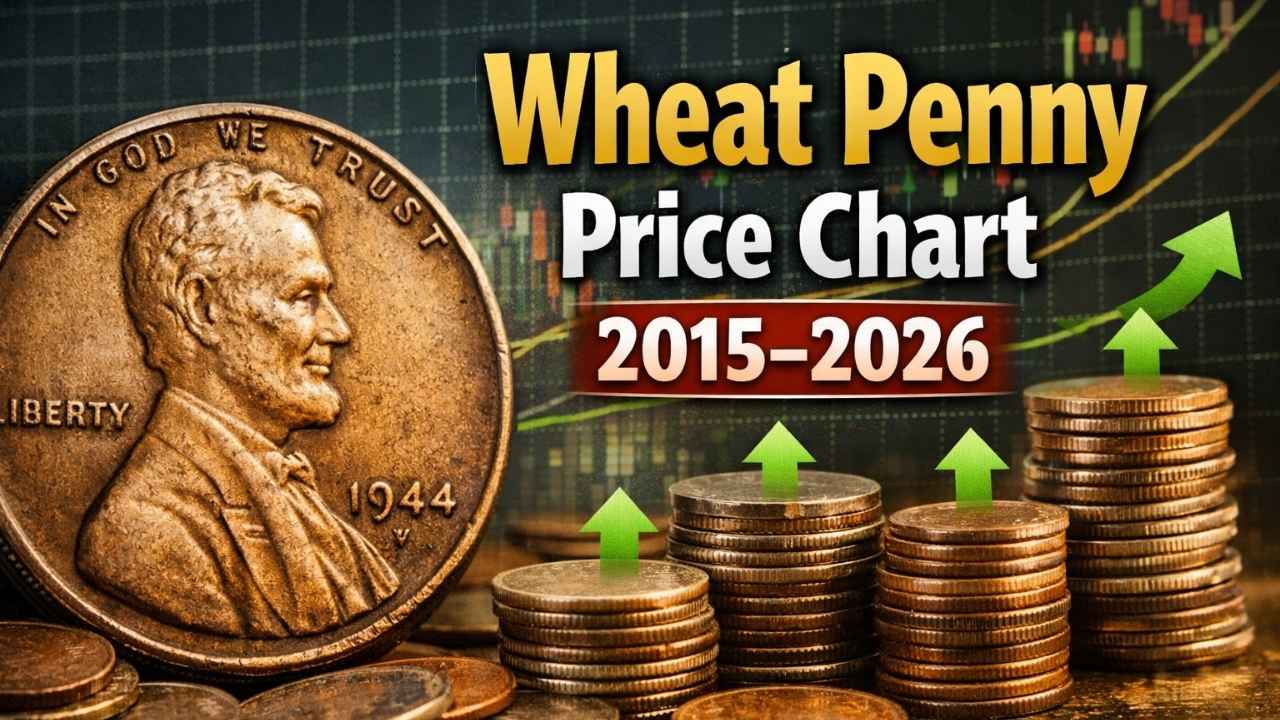
Wheat Penny Price Chart 2015–2026: Lincoln Wheat Pennies have remained one of the most collected coins in American history for more than a century. From casual hobbyists searching pocket change to serious investors bidding at major auctions, these small copper coins continue to attract attention. Between 2015 and 2026, the market for Wheat Pennies has experienced steady growth, selective spikes, and renewed interest driven by online marketplaces and social media awareness.
This complete collector’s value guide explores Wheat Penny price trends from 2015 through 2026, highlights key dates, explains grading impact, and provides detailed price chart tables for collectors at different experience levels.
Brief History of the Lincoln Wheat Penny
The Lincoln Wheat Penny was minted from 1909 to 1958. It features Abraham Lincoln on the front and two wheat stalks on the reverse. Designed by Victor David Brenner, it was the first circulating United States coin to feature a real historical figure.
Over the decades, billions were produced. While most are common, specific dates and mint marks are scarce. Certain mint errors and low mintage years have become legendary in the numismatic world.
Understanding price movement from 2015 to 2026 requires knowledge of three main factors:
Rarity
Condition
Collector demand
These three pillars determine the value of nearly every Wheat Penny.
Wheat Penny Market Overview 2015 to 2026
Between 2015 and 2018, Wheat Penny prices remained relatively stable. The market was steady, driven mainly by traditional collectors and silver copper metal values.
From 2019 to 2021, interest surged. Increased online coin sales platforms and stay at home hobby growth boosted demand. Many collectors reentered the market, pushing prices higher for key dates in high grades.
From 2022 to 2024, prices for common circulated Wheat Pennies stabilized. However, rare and certified high grade coins continued to rise in value.
By 2025 and into 2026, the market shows strong demand for:
Certified Mint State coins
Low population high grade examples
Rare error varieties
Historic key dates
Collectors now focus more on quality over quantity.

Wheat Penny Price Chart 2015 to 2026 for Common Dates
The following table shows average market values for common circulated Wheat Pennies from 1940 to 1958 in Good to Extremely Fine condition.
| Year | 2015 Avg Price | 2018 Avg Price | 2021 Avg Price | 2024 Avg Price | 2026 Estimated Avg |
|---|---|---|---|---|---|
| 1940 to 1949 | 0.05 to 0.10 | 0.05 to 0.15 | 0.10 to 0.20 | 0.15 to 0.25 | 0.20 to 0.30 |
| 1950 to 1958 | 0.03 to 0.08 | 0.05 to 0.10 | 0.10 to 0.15 | 0.15 to 0.20 | 0.20 to 0.25 |
Common Wheat Pennies have seen gradual increases mainly due to collector interest and copper value awareness. However, they remain affordable for beginners.
Key Date Wheat Penny Price Trends 2015 to 2026
Key dates have experienced much stronger appreciation. Coins such as 1909 S VDB, 1914 D, 1922 No D, and 1931 S have consistently gained value in higher grades.
Below is a value comparison table for key dates in Very Fine condition.
| Coin | 2015 Value | 2018 Value | 2021 Value | 2024 Value | 2026 Estimated |
|---|---|---|---|---|---|
| 1909 S VDB | 900 | 1000 | 1300 | 1600 | 1800 plus |
| 1914 D | 800 | 950 | 1200 | 1500 | 1700 plus |
| 1922 No D | 600 | 750 | 1000 | 1200 | 1400 plus |
| 1931 S | 90 | 110 | 150 | 200 | 250 plus |
The steady rise reflects limited supply and growing collector demand.
High Grade Mint State Price Explosion
The most dramatic increases from 2015 to 2026 occurred in Mint State grades, especially MS65 and above.
Certified coins with strong eye appeal and original red color have shown impressive gains.
Below is a sample price chart for 1909 S VDB in Mint State.
| Grade | 2015 | 2018 | 2021 | 2024 | 2026 Estimate |
|---|---|---|---|---|---|
| MS63 Brown | 1800 | 2200 | 3000 | 3800 | 4200 |
| MS65 Red Brown | 3500 | 4200 | 6000 | 7500 | 8500 |
| MS67 Red | 25000 | 32000 | 50000 | 70000 | 85000 plus |
High grade examples are scarce. As more collectors seek top population coins, prices have accelerated significantly.
Rare Error Wheat Penny Values
Error coins have also gained attention between 2015 and 2026. Social media exposure has increased awareness of dramatic mint errors.
Notable examples include:
1955 Doubled Die
1943 Copper
1944 Steel
Off center strikes
Wrong planchet errors
Below is a simplified high grade value trend table.
| Error Coin | 2015 | 2021 | 2026 Estimated |
|---|---|---|---|
| 1955 Doubled Die XF | 1200 | 1800 | 2500 plus |
| 1955 Doubled Die MS65 | 15000 | 22000 | 30000 plus |
| 1943 Copper | 250000 to 1000000 | 800000 to 1500000 | Multi million potential |
| 1944 Steel | 75000 | 150000 | 250000 plus |
Rare error coins continue to outperform common issues.
Copper Prices and Their Influence
Although collector value drives rare coin pricing, copper prices have indirectly supported Wheat Penny values.
Between 2015 and 2026, copper experienced moderate fluctuations. While melt value does not determine key date pricing, it creates a base floor for common Wheat Pennies.
Collectors are increasingly aware that pre 1982 copper cents contain higher metal content than modern zinc pennies.
This awareness has slightly increased demand for bulk Wheat Penny lots.
Condition and Color Impact on Value
Wheat Pennies are graded not only by wear but also by color designation.
Brown
Red Brown
Red
Red coins retain original mint luster and command significant premiums.
For example, a 1931 S penny in MS65 Brown may sell for a few hundred dollars, while the same coin in MS65 Red could sell for several thousand.
Between 2015 and 2026, premiums for Red designation coins widened due to their scarcity.
Certified Coins vs Raw Coins
The market has shifted strongly toward certified coins over the past decade.
In 2015, many collectors were comfortable buying raw coins. By 2026, most high value Wheat Pennies are bought and sold in certified holders from major grading companies.
Reasons include:

Authentication protection
Grade assurance
Resale confidence
Market transparency
Certified examples consistently bring stronger prices at auction.
Online Auctions and Market Growth
Online auction platforms significantly influenced Wheat Penny pricing trends from 2015 onward.
More buyers entered the hobby
Price transparency improved
Competition increased
The global accessibility of auctions allowed rare coins to reach a wider audience. This contributed to steady upward price movement, particularly for scarce dates.
Investment Performance 2015 to 2026
When comparing Wheat Pennies to traditional investments, rare key dates in high grades have performed strongly.
Common circulated coins showed modest appreciation.
Mid grade key dates experienced steady gains.
Top population Mint State coins saw substantial growth.
Collectors who purchased certified key dates around 2015 often saw notable value increases by 2026.
However, coin markets can fluctuate. Long term holding strategies generally perform better than short term speculation.
Beginner Collector Strategy for 2026
For collectors entering the market in 2026, consider these strategies:
Start with affordable circulated sets
Learn grading basics
Focus on key dates in mid grades
Buy certified coins for higher value purchases
Avoid cleaned or damaged coins
Knowledge remains the most valuable tool in coin collecting.
Advanced Collector Strategy for 2026
Experienced collectors may focus on:

Top population coins
Low census Red examples
Rare error varieties
Early die states
High eye appeal specimens
As competition for the finest examples increases, quality will likely continue driving premium prices.
Future Outlook Beyond 2026
The long term outlook for Wheat Pennies remains strong.
Reasons include:
Historical significance
Strong collector base
Limited surviving high grade coins
Continued interest in tangible assets
While common coins may only see gradual growth, rare key dates and elite condition coins are expected to maintain upward momentum.
The combination of history, rarity, and demand ensures that Wheat Pennies will remain a cornerstone of American coin collecting.
Final Thoughts on Wheat Penny Prices 2015 to 2026
The period from 2015 to 2026 has demonstrated that Lincoln Wheat Pennies remain a vibrant and evolving market. While common dates have seen modest increases, rare key dates and high grade certified coins have shown impressive appreciation.
Collectors who understand grading, rarity, and market demand are best positioned to benefit from future growth.
Whether you are building a simple circulated set or investing in top tier Mint State rarities, Wheat Pennies continue to offer opportunity, excitement, and historical value.
The small copper coin that once bought candy now represents one of the most fascinating segments of the coin collecting world. As we move beyond 2026, the Wheat Penny story is far from over.